A regular guy with an unusual road into fiction.
Ryan J. Russell writes stories shaped by history, human behavior, justice, hope, purpose, and a lifelong imagination that rarely stayed inside the boundaries of the world immediately in front of him.
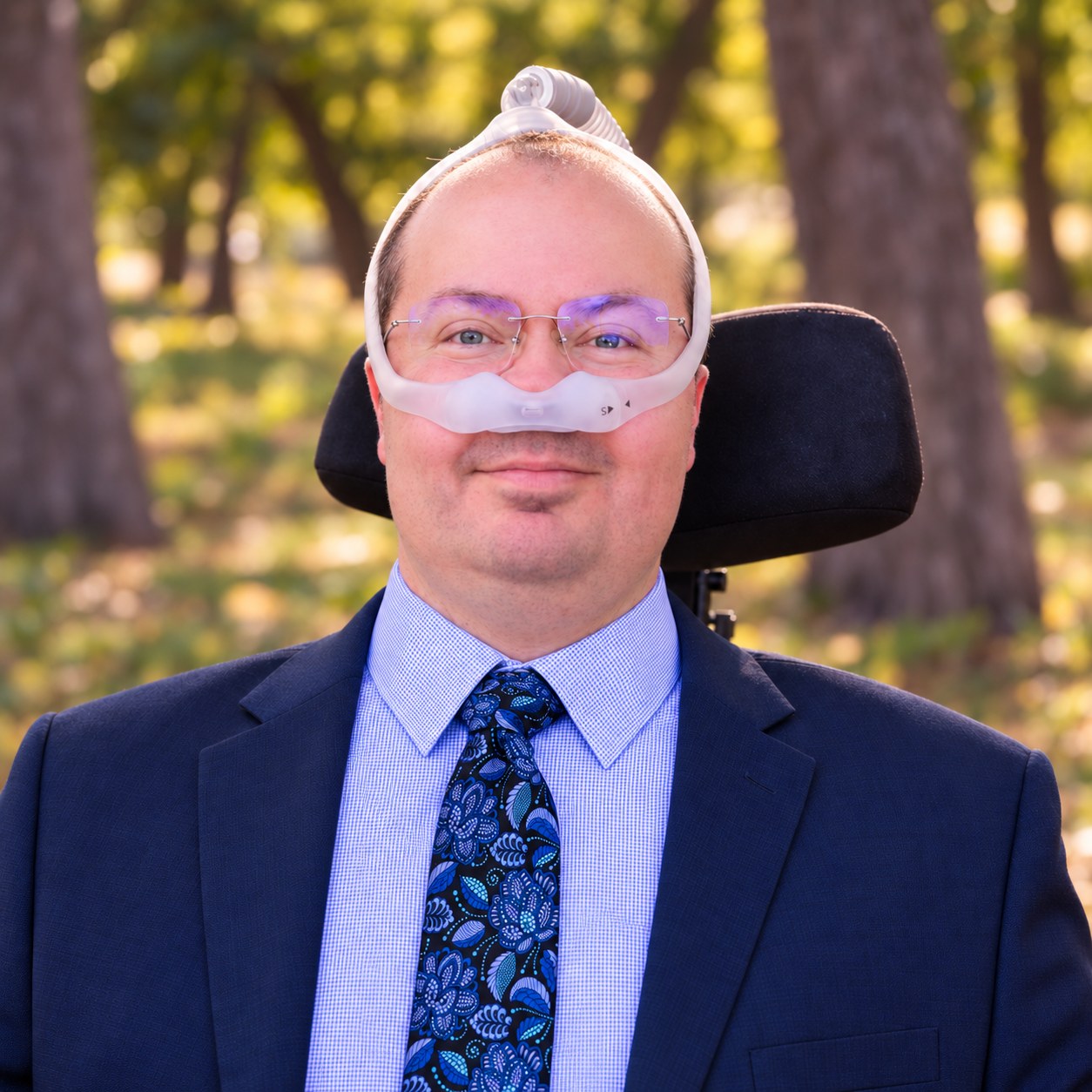
Ryan J. Russell
Ryan J. Russell is a fiction author and creator of the Rectify series. His work draws on a long fascination with history, psychology, anthropology, justice, resilience, moral choice, and the question of what gives a life purpose.
He holds a PhD in General Psychology and has studied across fields concerned with people and culture, including counseling, human relations, and anthropology. His education was never part of a perfectly mapped career plan. It grew out of curiosity: a desire to understand people more deeply and, if possible, use that understanding to help.
Ryan has Duchenne muscular dystrophy and uses a power wheelchair. His daily life requires substantial physical assistance, but he does not see disability as a shorthand for who he is. One story from his doctoral years captures that distinction: his dissertation chair knew him for years through the quality of his scholarship before meeting him in person and learning the extent of his physical disability. By then, she already knew him as a disciplined researcher, writer, and serious thinker.
He grew up in southern Arizona in a working family and now lives in the Kansas City area. He is married, a father, and still somewhat surprised by how far life has carried him from the future he once imagined.
Imagination came first.
I did not grow up expecting to become an academic or a novelist. My dad left high school, served in the Navy, and later worked as a welder and in mining. My mom earned an associate degree. We were a regular working family in southern Arizona, and I was mostly just trying to figure out what my life could look like.
What I did have very early was imagination. My grandpa helped kindle it. On his back patio, badminton rackets could become fishing poles and the backyard could hold whales. He read me Greek myths, fables, stories about heroes, books about animals and nature, and some of my Raggedy Ann and Andy books. He was the person who first took me to the library, along a little path from where he lived that felt secret and magical to me.
He died from a brain tumor on my ninth birthday. I had prayed hard that he would make it to my birthday, and I still believe, in my own way, that he was there. I only had him for a short part of my childhood, but what he gave my imagination never really left.
After that, ordinary places kept becoming other worlds. A ditch near my house could be a castle moat one day and a World War I trench the next. I had vivid, recurring dreams, and years later some of those dreams began finding their way into my writing.
Writing itself took longer. Physical therapy often pulled me away from English class, so grammar and punctuation were not the parts of writing that came most naturally to me. I had ideas, but I also had a lot of self-doubt. I kept thinking I had things I wanted to get out of me, but maybe I was not technically good enough to do it.
Eventually the answer became simple: just get it out. Start. Go for it.
School helped me build confidence. I discovered anthropology, then moved through counseling, human relations, and general psychology. My education has felt less like a straight line than a pinball machine: I get hit in another direction, discover something new, and somehow keep adding points. By the time I finished doctoral work, I had written enough that even when I could not name every grammar rule, I had developed a feel for when something worked.
A dream, a protector, and an alternate path.
Before Rectify, I had begun working on an epic fantasy called The Dreamer's Heart. It grew out of recurring dreams and the idea that, in another world, people might appear as what they truly are in their hearts. I loved the scope of it, but I also thought: if I am going to write something this big, maybe I should write something shorter first. Nobody knows who I am yet.
Then I had a dream.
I saw a man with a sword on his back moving through what looked like an Asian fortress, fighting his way through enemies to rescue someone. I woke up with the sense that this was the story I was supposed to write. The name Rectify came with it. Not long after, another image sharpened the idea: Rectify, the Avenging Angel.
At roughly the same time, I had heard the experiences of women who had survived violence and abuse. Some of those stories hit especially close to home because they involved people I cared about and wished I could have protected. Those experiences are not mine to identify or retell. What I carried into the book was the anger, helplessness, and desire to defend someone who had been hurt.
Living with Duchenne made that desire complicated. I had often wondered what I would do if, even for one night, my body could do what my mind imagined. I was barely nineteen when September 11 happened, and I have often thought that, in a different physical life, I might have tried to join the military. Rectify gave me a place to explore that alternate path.
I also believe inspiration is an active part of my writing. Some ideas are constructed deliberately. Others arrive in dreams or in moments of clarity that feel less like invention and more like something I am supposed to notice. Rectify was one of those.
Strength is more complicated than it looks.
I grew up with an actual hero in my family: my Uncle Dale. I knew him as a Vietnam-era Air Force fighter pilot who had gone on to do remarkable things, but what impressed me most was that he did not spend his life bragging about them. He could play the piano, sing the songs of the military branches, tell great stories, cook, ranch, and make a kid from a small Arizona town think the world was much bigger than it seemed.
He was also human. He struggled with alcohol and fought that battle too. One of the stories I remember most strongly was not about a medal he was proud of, but about a mission he regretted and a ribbon he refused to wear afterward. That stayed with me. Ability and courage matter, but conscience matters too.
He eventually received the Arlington burial he had wanted. In March 2025, I made a trip I once would have assumed was impossible for me and stood at his grave at Arlington National Cemetery. I have been to places I consider sacred; Arlington belongs in that category for me. Standing there, surrounded by the cost of service, was overwhelming.
Those ideas are part of how I think about heroes. I am an Eagle Scout. Service has always mattered to me. But I no longer think heroism means being invulnerable or always having the answer.
Being a hero sometimes means being willing to be rescued yourself.
Dan Campbell contains parts of me, but he is not me. In many ways, he is closer to an alternate eighteen-year-old version of me: serious, intense, loyal, and very black-and-white about right and wrong. At eighteen, I wanted the world to fit cleanly into categories. Age, relationships, study, failure, and experience have taught me that there is more gray than I once wanted to admit.
That is one of Dan's flaws. At first he can look almost too disciplined to be flawed, but his need for rules and certainty can become a way of avoiding the messier work of living. He has to learn that strength is not the same thing as control, that good people can be wrong, and that admitting weakness does not erase courage.
I want readers to finish a Rectify story thinking about how they can be better, serve someone else, protect people who need it, and rethink what bravery actually means. Hope and purpose are themes that keep showing up in nearly everything I do. I also want readers to close the book and think, I want to see this on a big screen—or as an anime.
The rest of the guy behind the stories.
Long before becoming an author or earning a doctorate, Ryan wanted to be a husband and a father. Finding the right person mattered enormously to him, and family is now one of the most important parts of his life. He keeps the details of that family life private, but not its importance.
He moved from southern Arizona to the Kansas City area and still carries plenty of Arizona with him: a love of open country, ranching, and the long-running dream of someday having enough help and space to keep all the chickens he wants.
He loves history, sports, gaming, road travel, country music, and '80s music. His shelves and imagination have been shaped by historical fiction, science fiction, and fantasy—from Bernard Cornwell to Star Wars, The Lord of the Rings, and the Spellmonger series.
A few things Ryan likes
- History in almost any form
- Historical fiction, fantasy, and science fiction
- Gaming and working at a computer
- Sports and supporting Volt Hockey
- Country music and '80s music
- Ranching, chickens, and rural life
- Road trips and seeing the country from the ground
One long-term goal: visit all 48 contiguous U.S. states by road. Hawaii is not ruled out if the right ship ever makes the logistics possible.
The Rectify story is still growing.
Ryan is currently revising and expanding Rectify: The Avenging Angel while continuing work on Book Two, Rectify: The Ancient Centurion.